The strength and longevity of concrete structures stand as testaments to both safety and quality.
Yet, beneath the surface, reinforcing steel bars, commonly known as rebar, are working hard to keep these structures secure.
The concerns associated with incorrect or inadequate rebar placement, corrosion, and structural defects are all too real when in the middle of a project.
These issues can lead to catastrophic consequences, including building failures, safety risks, and the burden of costly repairs.
This is where rebar scanning, particularly with the aid of Ground-Penetrating Radar (GPR), emerges. By employing advanced technology and experienced technicians, reputable survey companies can accurately scan and assess rebar.
The Role Of Rebar Scanning In Concrete Structures
Concrete structures support skyscrapers, bridges, and infrastructure.
The reliability and longevity of these structures depend significantly on a hidden but critical component: reinforcing steel bars, commonly known as rebar.
Rebar is a network of steel bars strategically placed within concrete during construction. These metal rods serve a vital purpose: to reinforce and enhance the strength and durability of concrete structures.
While concrete can withstand compressive forces well, it is considerably weaker when it comes to tensile forces, which involve stretching or bending. Rebar, with its tensile strength and flexibility, complements concrete’s weaknesses.
Yet, the role of rebar is not without its challenges. Improper rebar placement, neglect, or corrosion can compromise the structural integrity of a building or infrastructure.
To prevent these pitfalls and ensure that concrete structures stand strong for generations, it is crucial to understand the importance of rebar scanning.
Detecting Rebar Issues With Ground Penetrating Radar (GPR)
GPR surveying, a non-destructive testing method, has emerged as a game-changer in detecting rebar placement, corrosion, and various other issues hidden within the depths of concrete. The resolution of image provided by a GPR survey is considered much clearer and more beneficial than other techniques.
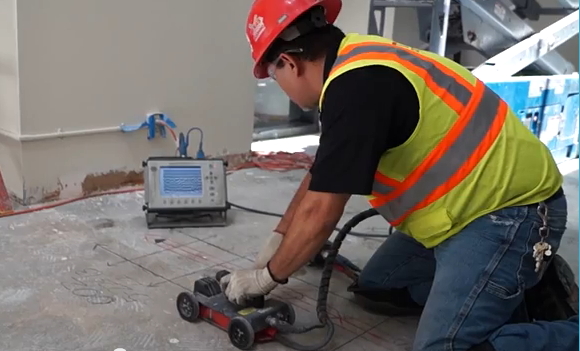
The GPR transmitter sends radar signals into the ground, and the GPR antenna detects them. Ground Penetrating Radar can be used with different antenna frequencies to provide a range of penetration depths and resolutions immediately on site.
So, how does GPR reveal the state of rebar within concrete?
- Rebar Placement
GPR can accurately detect the presence and positioning of rebar within concrete. This ensures that rebar is correctly placed according to design specifications, minimising the risk of structural defects.
- Corrosion Detection
Over time, rebar may corrode, potentially weakening the concrete structure. GPR can identify signs of corrosion early, allowing for preventive maintenance and avoiding costly repairs.
- Structural Issues
GPR is a powerful tool for identifying structural issues such as voids, delamination, or cracks within concrete. Early detection of these problems is critical for maintaining structural integrity and safety.
- Non-Destructive Testing
One of the key advantages of GPR is that it is non-destructive, meaning it does not damage the concrete during the scanning process. This makes it an efficient and cost-effective way to assess the condition of concrete structures.
Conclusion
The unseen challenges of rebar issues—incorrect placement, corrosion, and structural defects—can cast shadows on the longevity and safety of our built environment.
These challenges pose not only financial burdens but also safety risks, and in some cases, catastrophic failures.
Ground Penetrating Radar (GPR) technology, along with the expertise of experienced technicians, allows us to discover these issues without dismantling the ground of your project, revealing the any errors that need to be sorted. Ultimately, the results from GPR Concrete Imaging can be used to confirm as-built drawings and determine reinforcement detail.
If you are looking for some more advice on GPR surveys, and how they can support rebar scanning, make sure to get in touch with us at Intersect Surveys for expert advice.
For more details, please visit https://intersectsurveys.co.uk/blog/rebar-scanning-ensuring-concrete-structures-stand-strong